
Turin and the Savoy residences
Italy's first capital, eighteen kilometres of arcades and a crown of palaces.
Turin was the capital of the Duchy of Savoy, then of the Kingdom of Sardinia and finally, from 1861 to 1865, of the Kingdom of Italy. That left it a centre laid out on the drawing board, with straight streets and regular squares, and a quantity of palaces that a city of nine hundred thousand people would not normally have.
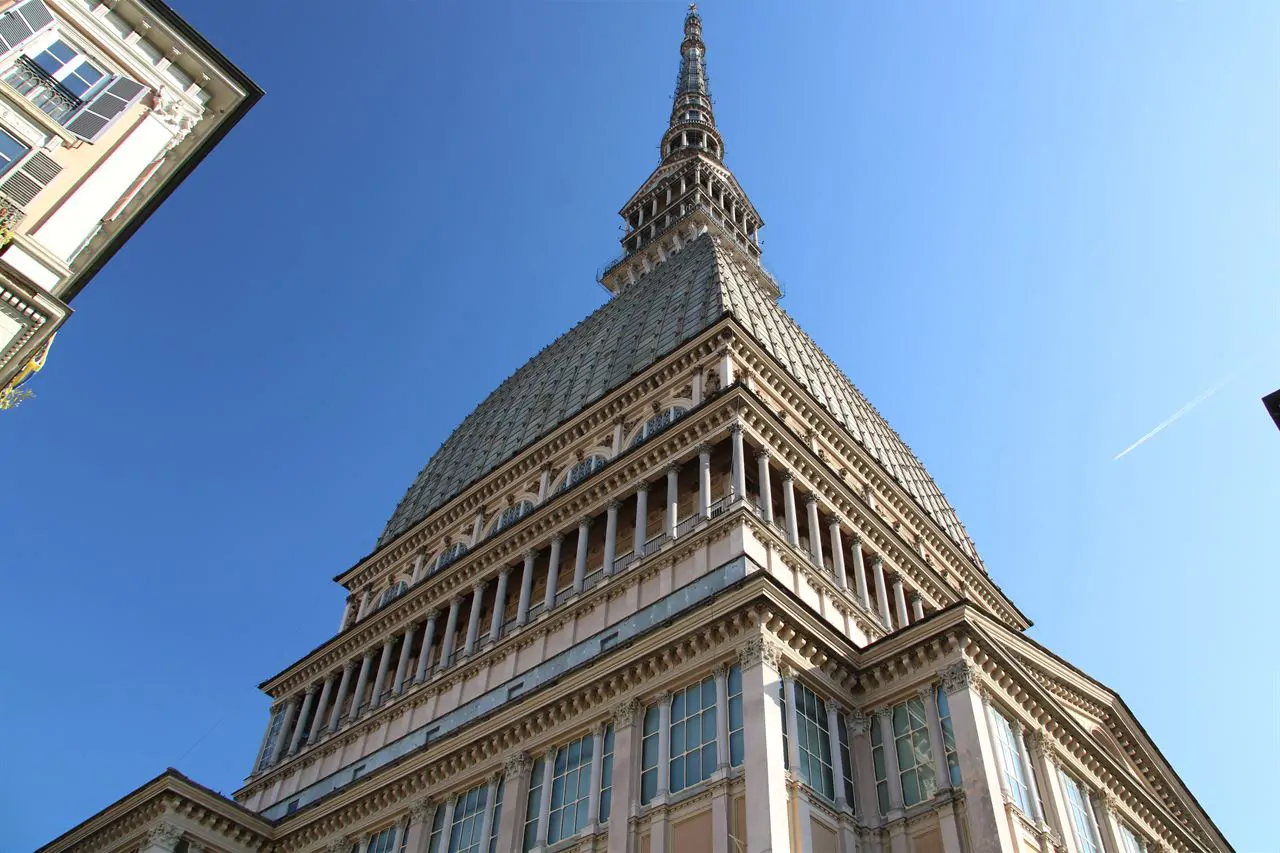
Its emblem is the Mole Antonelliana, a hundred and sixty-seven metres high, begun in 1863 as a synagogue and turned into something quite different: today it holds the National Cinema Museum, and a glass lift rises through the void to the dome. Not far away, the Egyptian Museum holds the most important Egyptian collection in the world after Cairo.
The residences
Around the city the Savoys built a ring of country residences, Unesco heritage since 1997. The palace of Venaria is the largest and has enormous gardens; the hunting lodge of Stupinigi has a star-shaped plan and a bronze stag on the roof; Racconigi has an English park; the castle of Rivoli, left unfinished, today houses a museum of contemporary art.
The city was also the capital of the Italian motor industry: Fiat was founded here in 1899, and the Lingotto, with its test track on the roof, is now a conference centre with an art gallery inside. Above the city, on the hill, stands the basilica of Superga, from which the whole alpine arc is visible.
From the lakeside campsites Turin is an hour and a half away, and it is easy to reach by train as well. In the city it is best to leave the vehicle in a park-and-ride and use the underground: the centre has a restricted traffic zone and the arcades are walked.